
Search for "rewrite resume" or "resume optimizer AI" and you'll find dozens of tools that hand you an AI resume rewrite in seconds. Read it closely before you send it. If the job asks for a skill your resume doesn't show, there's a fair chance the rewrite shows it anyway.
Hiring managers have noticed. In a Harris Poll for Express Employment Professionals, 86% of US hiring managers said AI makes it too easy to embellish a resume, and 80% said resumes don't match candidates' real-world skills at least some of the time. In Resume Now's 2025 survey of HR workers, 94% said they'd come across misleading or inaccurate AI-generated content.
Every line on your resume is something an interviewer can ask you about, and a good interviewer will probe and press. I've conducted countless interviews, and my team and I learned to zero in on claims that needed evidence behind them. The only way to test one is to ask for specifics. That's why Tailored Resume, the paid step after the free Resume Cleanup, works the way it does. Below is what it did to a made-up resume on the live site, what it refused to add, and why it costs a credit.
Why Does an AI Resume Rewrite Make Things Up?
Because filling gaps is part of how language models work. They write the most likely next words, and when a job asks for a skill your resume never mentions, the most likely resume for that job often includes it. NIST calls this confabulation, and says it's a natural result of the way these models are designed.
That's from the US government's risk profile for generative AI, and the model makers say much the same. Anthropic's guide to reducing hallucinations says its techniques cut them significantly but don't eliminate them entirely. A rewrite that's honest only because the prompt asked nicely will be honest most of the time.
Most of the time isn't good enough for a document with your name on it. So Tailored Resume doesn't take the AI's word for it. Code checks each line the AI writes against your original before you see it. The first post in this series shows where the AI sits in that process, and why we don't let it read your resume from scratch.
What Does Tailored Resume Do to Your Resume?
It rewrites your resume for one job, using only what's already in it. Your summary is written for that job, lines are reworded in the job's language where your resume earns it, your skills are ordered by what the job asks for, and anything the job wants that you haven't shown becomes a question for you.
To show you, I ran a made-up candidate through the whole thing on the live site. Dana Whitfield is a dispatch supervisor in Toronto with a resume full of the usual problems: an "I" statement, a date of birth, a line that starts with "duties included." The job is a made-up Dispatch Supervisor role near Toronto, and the Fit Score found nine requirements in it. Dana's resume shows most of them, but not Ontario Hours of Service rules, not a telematics platform like Samsara, and not French.
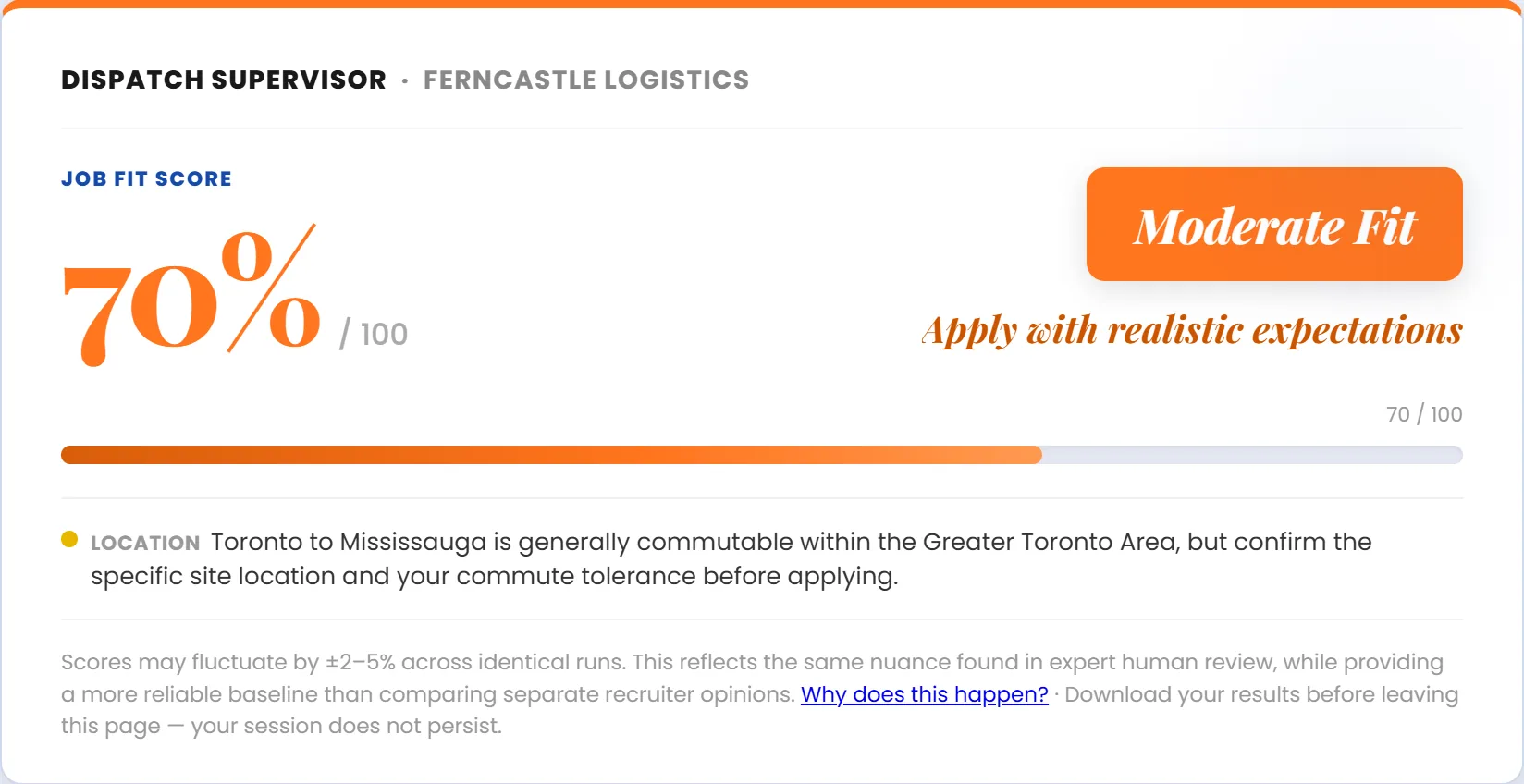
Resume Cleanup tidied the basics for free. The Fit Score came back at 70%, a Moderate Fit, with every requirement marked as a match, a partial match, or a gap. That cleared the 60% that Tailored Resume needs.
Then Tailored Resume, for one more credit. Here's what came back.
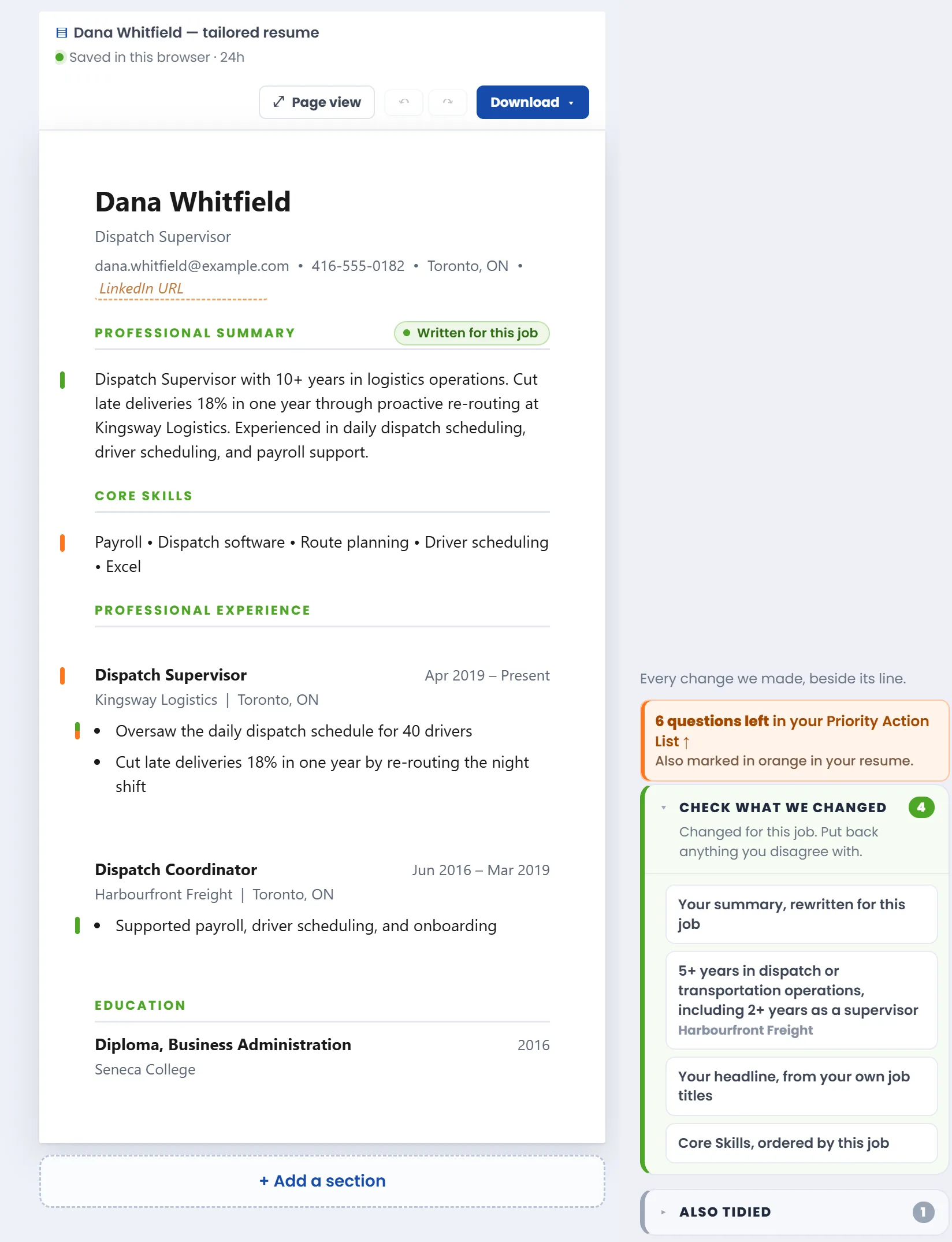
Her summary was rewritten for this job: "Dispatch Supervisor with 10+ years in logistics operations. Cut late deliveries 18% in one year through proactive re-routing at Kingsway Logistics." Her skills now lead with what the job asks for first. And "duties included: payroll, scheduling and onboarding" became "Supported payroll, driver scheduling, and onboarding."
Look at that verb. Her resume lists those as duties, and the rewrite keeps them that way: "Supported," not "Managed." The 18% is still 18%, and the 40 drivers are still 40.
How Does It Keep the Rewrite Honest?
In three ways. Gaps stay gaps: what the job wants and your resume doesn't show is listed, not written in. Code checks each line the AI writes, so your numbers stay yours and your claims don't grow. And every change sits beside your original, with a button to put it back.
Gaps become questions
Dana's resume doesn't mention Ontario Hours of Service rules, so her tailored resume doesn't either. Instead, the first item on her Priority Action List asks: "Do you apply Ontario Hours of Service rules in your current role?" If she does, she adds it in her own words. If she doesn't, it stays out. One of the biggest lessons I've learned in recruitment is never to assume a candidate has a qualification their resume doesn't show. Tailored Resume works the same way: it asks instead of assuming.
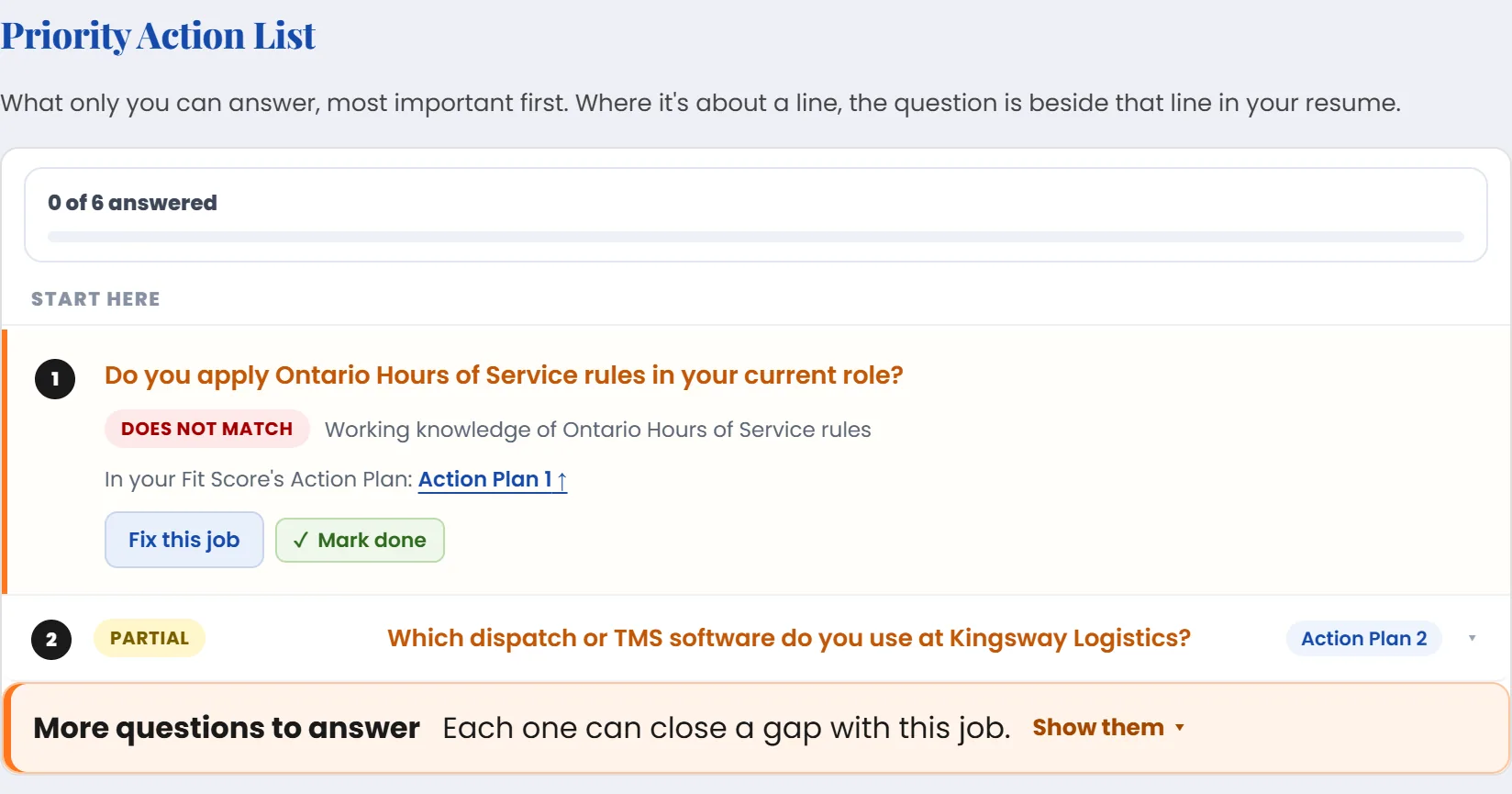
The page also says what it left out, and why: "Not added, because your resume doesn't show them yet: Ontario Hours of Service rules, Samsara or another telematics platform, French language skills."
Code checks every line
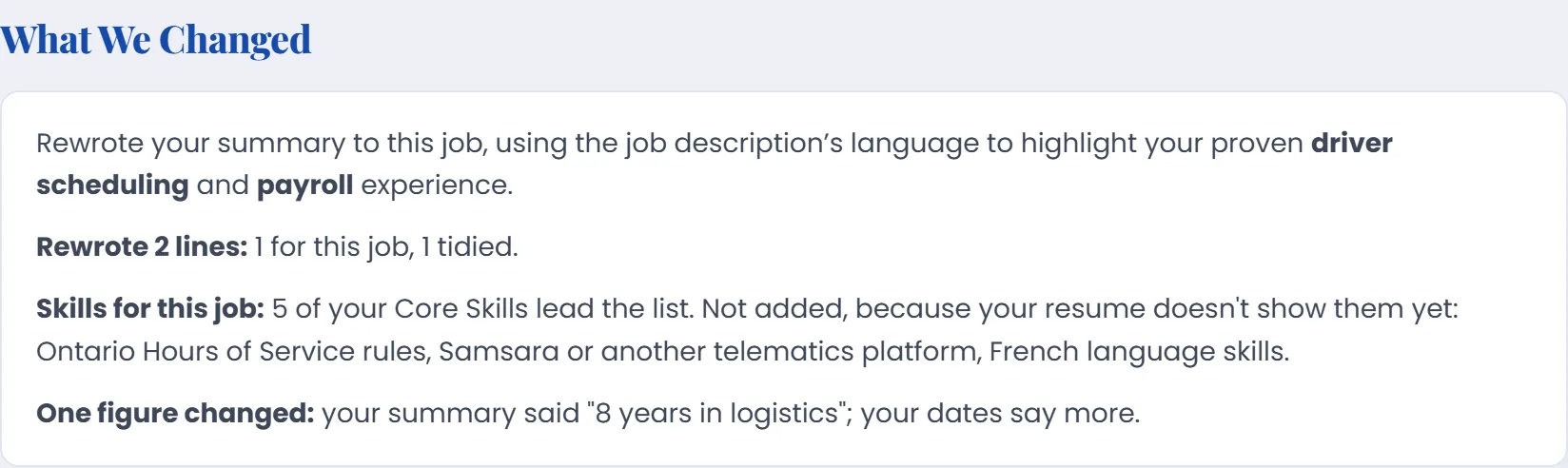
Before you see the rewrite, code compares each line with your original. Praise you didn't write about yourself is refused. If you "assisted" with something, the rewrite can't promote you to "led" it. Numbers come from your resume, and when one changes, the page tells you why. Dana's summary said "8 years in logistics," but her own dates add up to more than ten, so the page flagged it: one figure changed, because "your dates say more."
You can put anything back
Every change sits in the margin beside its line, under "Check what we changed." Disagree with one and "Put it back" restores your original. You can also click any line and edit it yourself, then download the result as a PDF, a Word file, or plain text.
One honest caveat. AI wording isn't repeatable word for word, and the same input can come back different on a second run. When I ran Dana through again, her summary stayed much closer to her original wording. What didn't change: neither run added a skill she hasn't shown.
What Happens When You Get to the Interview?
Recruiters read fast. In a 2025 TopResume survey, over a third of hiring managers said they can spot an AI-generated resume in under 20 seconds. The bigger test comes later, when someone asks you to talk through a line. Behavioral interviews rest on the idea that past behavior predicts future performance, so you'll be asked for real examples. As a recruiter, I give a line that looks inflated extra attention in an interview. Is your past success real, and is it something you can repeat in the role I'm hiring for? A claim like that falls apart once I ask for specifics.
That's where gaps come back, and why Interview Prep, the third step, works from the same ones. Dana's prep flagged her Hours of Service gap as one to prepare first.
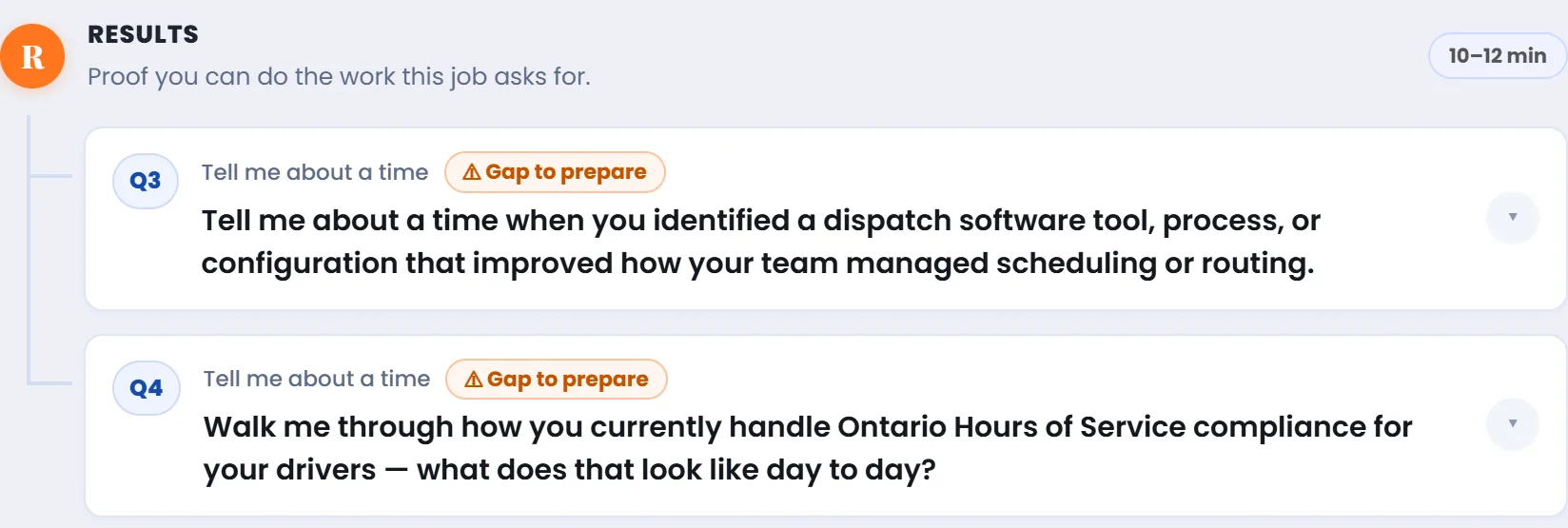
Its last line is the rule the whole product is built around: "Everything you say in the room must be consistent with what is on your resume."
Why Does Tailored Resume Cost a Credit?
Because every run uses a large AI model, and that costs real money each time. Resume Cleanup reads your resume in your browser with rules, so it's free. Tailored Resume sends your resume to an AI model and then checks the result with code, and credits are priced as close to that cost as we can.
The reasons Resume Cleanup can stay free are in the second post in this series, and the first post does the math on what AI resume reading costs at scale.
Tailored Resume unlocks after a Fit Score of 60% or more. Below that, the Fit Score's verdict is not to apply, so there's nothing to tailor. A tailored resume from scratch takes two credits: one for the Fit Score, one for the rewrite. Everyone gets 3 free credits every 30 days, with no card needed. After that, a single credit is $0.99, and packs cost less per credit.
Try It on Your Own Resume
A recruiter's first look is short. In Ladders' eye-tracking study, it lasted 7.4 seconds. Make those seconds count with a resume written for the job, and make sure every line on it is one you can talk about.
Start with Resume Cleanup, which is free, then run the Fit Score against the job you want. If you score 60% or more, Tailored Resume is one click away.